
Will AI eat away my job?
On what comes next for PMs, and other kinds of knowledge workers...


Remember last year? That’s when I made my last post.1

I wrote a post on what Product Management is. I promised I’d do a follow-up on how will my role change with the coming times. Turns out, I wasn’t kidding! Even I’m surprised that I’m writing a sequel, after several failed promises.2
Note that whatever I say in the rest of this article should not be interpreted as anything beyond informed speculation, and is purely based on my experience working with these new tools so far. These views are personal, and in no way are linked to what my employer says or suggests.
You gotta be safe in these times, you know?
Now, here comes the fun part...
This is for my friends with shitty attention spans.
Will AI eat away my job?
1-mark answer: no.
2-mark answer: no, but I know that my role’s gonna change greatly over the next 3-5 years. The fundamentals of what a PM does are going to get more visible and impactful.
For the 20-mark answer, read on…
People are either too excited or too scared about AI and the way it might displace them.
However, to think of things from that angle (i.e. AI is being developed to replace humans and the jobs they do) is a wrong way to approach it.
Between the time I posted the prequel of this post till date, there have been several takes on the future of Product Management by some stalwarts on this topic. I’ll link to their takes towards the end of this post.
But I want to use this space to center this discussion to what would happen to our kind, especially to the Product Managers in India. But what I’m saying is pretty generic and should apply to everyone under the sun, including all sorts of knowledge workers (tech and non-tech).
A short view back to the past...
For those who don’t watch F1 and are not aware of this meme, I got you...
When I began my previous article (again, here if you haven’t read it already), I quote Lenny Rachitsky from his post on Product Management, where he mentions,
Your job as a PM is to deliver business impact by marshaling the resources of your team to identify and solve the most impactful customer problems.
Then I went on to mention that Product Managers are paid for the leverage that they generate with their work. The kind of effort they put in towards the job is only as valuable as the output that they generate for their team.
In that sense, PMs already have a headstart as compared to the other jobs on the market, which traditionally involve submitting deliverables (code, designs, copies) for income.
Also, in that post, I tried putting all the knowledge work that anyone does through this (oversimplified) formula.

This equation will be the central thesis of today’s discussion.
Some hard facts
Love it or hate it, we live in a capitalist society. Turning around a profit is the most generous thing you can do for the world.3
If you remember third-grade mathematics, profit = selling price - cost price of anything you build.
Basically, it should cost you less than what you’re selling the item for to profit and keep running your business.
In the anticipation of turning around a profit, you recruit people who can find what should you build and how should you go about changing it4 to be able to stay relevant.
So, as a software business, you recruit people who can ideate, develop, grow and evaluate software solutions for you. You increase the cost of operations just so you can turn around a greater outcome which will (hopefully) more than cover the cost borne by hiring.
In terms of the direction of progress, most businesses profit by giving the world tools to slow down time or speed it up.5
When we say slowing down time, we mean to entertain, to pleasure, to make times worth remembering. When we talk about speeding up, it usually means skipping to the good part: by reducing the time it takes to build something, heal someone or just any job done.
With me, so far?
I don’t want to get political, but no business stands to benefit by hiring more people to do the same job. You may hire them for goodwill, but as a business, if you really wanna make it, you’ll try and make sure you’re getting the most out of the fixed number of people you’ve hired.
And that’s why we get all so existential about AI: we fear that it can take our job because we believe that businesses can go on and deliver the same outcomes without us. The businesses we work for, would no longer need us and we’ll eventually be doomed.
I’d go on and say, the fear does sound reasonable, does it not?
Now, where can we go wrong?
Businesses hold no interest in either creating or cutting jobs. May I be bold enough to say that jobs are lost because of a lack of innovation. Because there are no better ideas for the business to pursue. In a thriving organization, the same number of people eventually start looking around for other opportunities to capture the same market and bring out things that were previously deemed to be impossible.
Which means that even though a lot of “programmable” jobs can vanish in the next few years, a smart business will try to juice out more creativity out of the people they already have in their org without necessarily needing to shrink down.
But before going off another tangent, I want to refocus our discussion on the multipliers of knowledge work and how I see them changing.
Knowledge work
= Labour x Leverage x Taste
Labour
With AI going berserk, completing tasks, keeping an eye for any changes to instructions – I anticipate the labour part of this equation to dwindle with improvements to AI. A new element, which is purely managerial — orchestration — becomes super important.
That means that all aspects of your job which relate to labour — something as simple as writing a spec or as complex as telling the 10th stakeholder why was the ship date of a certain feature delayed, could be taken care of by AI.
Understanding orchestration is pretty simple. Remember this episode in Tom and Jerry where Tom becomes the conductor of a large orchestra? That’s what most people will end up doing in their day-to-day.
Give instructions to your computer, review the tasks done by it and move on to the next task at hand.
There was a time, which I like to remember as the “ugly middle”, when most of these tools were doing a half-assed job at writing docs or generating code, when people lost interest in them. That was simply because the technology was a good proof of concept, but it was not mature enough to take care of the tasks as promised.
But now, based on my personal experience of using tools like the Dia Browser, Cursor and Rovo’s Jira/Confluence integrations, I’ve seen phenomenal improvements. These tools can write complete code, generate documents and presentations with utmost clarity and help people turn around work without needing to master Excel or Powerpoint or Google Docs.
My best advice to PMs is something that I’ve been following myself for the last year or so: try out new tools unabashedly at work, to the point where they start breaking. Pro tip: don’t tell your colleagues that what you’ve been making is generated by AI. Otherwise they’ll come hounding at you even if the artefact is better than what they could’ve created themselves!6
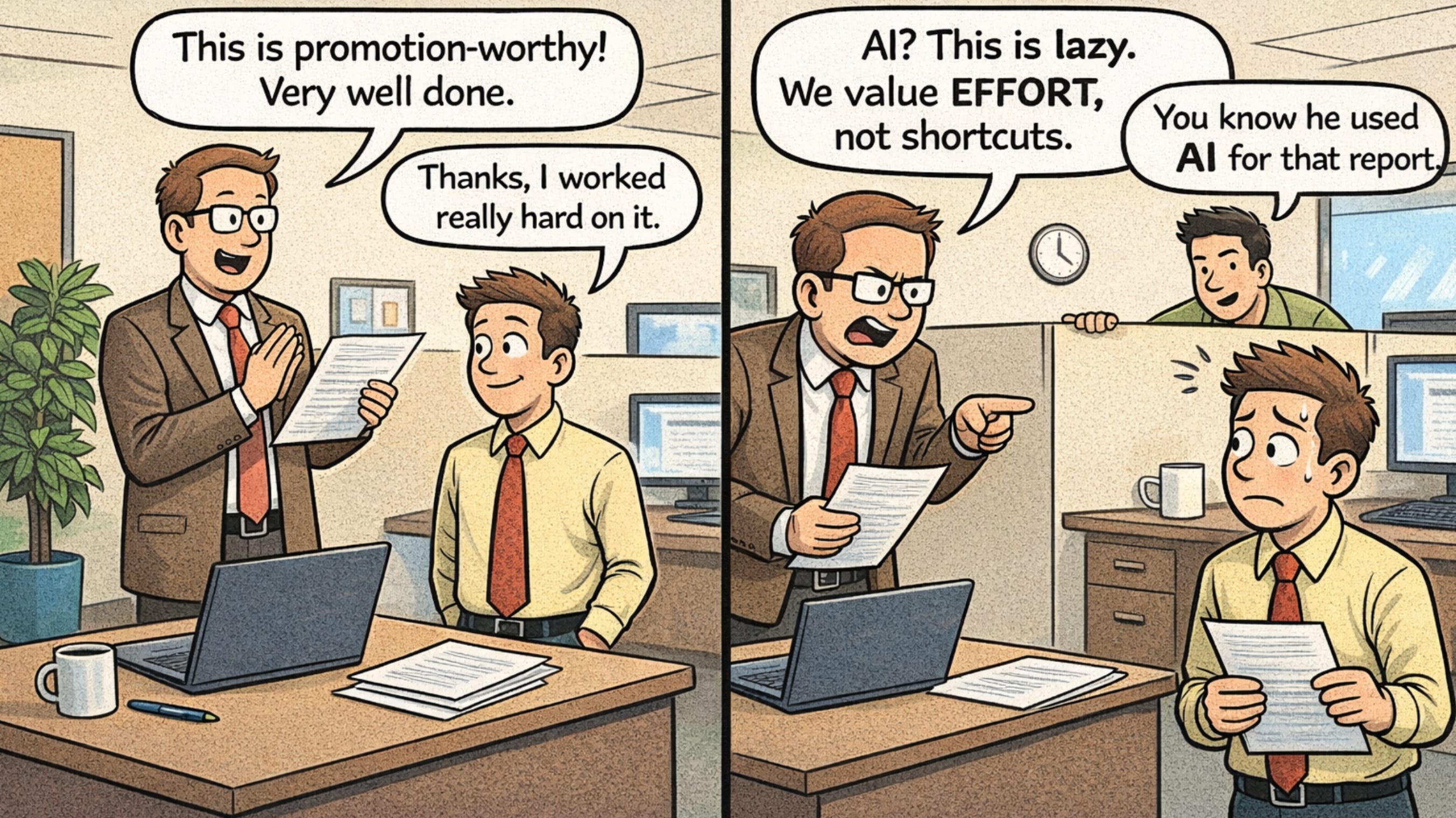
If I wouldn’t be able to use ChatGPT to create this comic strip, I don’t think I’d have been motivated enough to commission it/hand-draw it and would’ve avoided putting it in this post at all.7
And if your job is defined by the number of hours you put to refine that doc, none of whose inputs are your own, then you’re not really in the right place.
You need to start looking at your work not from the lens of the output that you generate, but the outcomes that you eventually drive in your role.
Leverage
This is where the value of a PM, or for that matter, any kind of manager comes in. You might be working 10 hours a day working on a project for 10 months that only generates $10 in incremental revenue8. As a knowledge worker, in general, that’s not healthy — both in terms of lifestyle and for your career growth.
As a PM, you should look for ways to improve your leverage if you don’t have it already. If your job is to marshal resources to do the job, then marshal them as hard as you can. There are AI agents that could get the job done for you — from copywriting to creating prototypes, from creating custom emails to full-fledged presentations for execs — use all that you have to your advantage.
Get licenses to the most expensive tools your company could afford. In most situations, these tools will cost you a lot less than hiring someone full-time9. Plus, the quality is also kinda standard (see the next section for more on that quality question).
Without technology, more agency typically translated to more labour. With intelligent systems, more agency now means more leverage. More tasks done per minute. Time flies faster, things get done. Money flows in.
Even if you’re an IC (Individual Contributor) and don’t manage a team of people, think of yourself as a manager of agents. Recruit the best of them and see yourselves rising the ranks as someone who can pull bad business out of debt and good businesses straight to the moon!
But leverage is not just about recruiting agents at work. AI can be of limited help here, as influencing your org (especially upwards) will remain a key skill and in fact, get stronger as execution is largely delegated. Soft skills are your friend.
Taste
This is something which makes all the difference between a good and a great PM. And it’s pretty unfortunate to see that people talk about taste all the time and yet under-emphasize/seldom practice it.
People don’t work hard just for the sake of it. The best craftsmen you know — from the Michelangelos to the Linuses of the world — spent extra time in the kitchen because they wanted to cook their meals to perfection. They knew that there’s an ideal state worth striving for, and they wanted to put as many iterations as possible to make sure that the finished product is as per their expectations, and often well beyond what anyone could’ve imagined.
The good and bad thing about AI tools is exactly this. You can get yourself to a passable quality of output with ever-improving models, but it still takes a genius and a shitload of effort to produce something otherworldly. The floor is raised for everyone, but that doesn’t mean that the ceiling is still the same height.
If you think you lack clarity on what needs to get done out of an AI tool, spend time honing your craft manually. Hone attention to detail in such a way that no AI could beat you at what you’re good at. Reviewing roadmaps, codebases, customer feedback — all those are things that could only come about with deliberation.
A good indicator for good taste is when you can argue with a state-of-the-art AI model about the generated output and point out exactly what needs fixing for the output to elevate to the next level with high confidence.
A lot of high-leverage managers have these AI tools under their belt: production is commoditized now. And that’s why we’ll see more attempts at the same market problem, but only one will stick. The one which is the best out there.
For example: in the thousands of productivity apps, Notion stood out. In the thousands of web browsers available in the market, Arc stood out. Both iterated for excellence and tastefulness, and a kind of user quality which makes them hungry for more.
All in all, if I were to flash that ugly equation right before your eyes again (with some modifications)…

This is how I feel things would change for everyone.
Back to the original question
The leading question of this post was whether or not AI will take away my job.
I think it will take away parts of the job that I got good at, where AI will outperform me everytime. These were tasks that I dreaded to do anyway — think generating summaries of meetings or searching for the Confluence docs. Some of these problems are harder to solve than the others, but in the 4-5 year horizon, I lowkey see us getting to a point where humans don’t have to be in loop for these tasks at all.
These tasks, lovingly called b*tchwork, are anyway things I don’t enjoy doing.
However, all I know is that if I’m hired in a company to do b*tchwork, I’ll be easily replaced by a system that does it faster and more reliably. Good news? Yes, for some. Not for many!
The sad reality is a lot of the PMs work as arbiters and delegates for someone who’s not “free enough” to look into the minor details, without adding original inputs to problem statements. Also, I believe when PMs over-index metrics and OKRs without questioning them and thereby trade off the simple rule of Product Management — build something your user wants and is ready to shill a penny for — they should brace themselves for a crash.
If the company you’re deciding to work for is flexible enough to accommodate your (well-reasoned) creative input, is able to work nimbly across tasks, say no to what’s unimportant, only then can they expect to stay at that company and thrive there.
Being able to build an intuition of what my customers want, influence my team to do the right thing and use the (still) limited bandwidth of my product teams is something that is essentially my job. Everything else takes care of itself, as it should’ve already.
The bandwidth which then gets freed up can be used for exploring other domains which were just as important to pursue earlier. There were things that we thought wouldn’t fit as a 3-month long roadmap item, or something truly unimaginable but addresses a key user pain point.
Some of these problems are not pretty and exciting. Think making adjustments to a billing platform which is not prepared for a new product acquisition, which is what decides what gets built in-house v/s what’s acquired — these are critical decisions which need to be taken by humans. High leverage, high cost if things go wrong, but millions of ways to approach this problem. The AI does the work for me, but which route to take would still be decided by me.
The more exposure you have to a range of problem statements, the more you’ll hedge your career. The hedging will come about by improving taste, standards of excellence and simply the craft of building products.
Because at the end of the day, my favourite definition of Product Management is:
The art and science of building the right products for the right users to solve their problems.
And that’s never going out of fashion.
Some interesting takes on this topic
A lot of what I presented above comes from my own experience of seeing product teams run around me, mostly in India. Here are some interesting posts by people I look up to on this topic, which helped me form a more matured opinion on my take above.


The Ken - Who killed the art of Product Management in India?
 Ivan Zhao@ivanhzhaohttps://t.co/fxHYR6S29D7:55 PM · Dec 22, 2025 · 5.85M Views345 Replies · 2.51K Reposts · 12.4K Likes

Yes, I like to make that joke that if I enter the washroom at 2359 hrs and 40 seconds for a piss, I’d spend a year pissing. Sorry.
I’m kidding again, I’ll get to those sequels soon. Really, really soon. Trust me as much as I trust myself.
I’m in no mood to debate this right now. Sometime later maybe over a glass of Masala Dew, maybe?
Here’s an idea for another post: my mental model on progress. Yes, it’s gonna rain hard this year!
I’ll definitely write about this in detail over here. But in short, a way to think about this is: since time is the only scarce resource, anything which helps us manipulate it has value in the world.
This is just the opposite of what happens at Atlassian (and the office also looks much better than that cartoon above). Using AI through novel ways is always encouraged; heck we even have a dedicated Slack channel of 1000+ active participants trying out new AI tools and requesting for enterprise licenses. Do apply if you’re interested!
I’ll enter this debate of “AI-generated art/slop” in a future post. We’re not fucking around this year!
Clarifcation: This is for when revenue is the sole purpose of doing that work. It’s merely an example. There could be other metrics that your business may target: say # of hours spent, new customer signups, tokens burned or something entirely different.
Totally depends on the job though. In my experience, coding tools give the biggest ROI to your team, followed by copywriting. Generic licenses such as ChatGPT and Google Gemini are able to do a bunch of things, and can help you get your toes wet. I’m still exploring the new ones such as Claude Cowork and I’m yet to form an opinion on them, but a lot of knowledge work problems still remain unresolved.